
How acoustic panels work — in plain English
Rooms echo because sound bounces off hard surfaces — plasterboard, glass, concrete, timber — faster than your ears can separate one sound from the next. Acoustic panels absorb that energy inside a soft fibre matrix instead of reflecting it back. The result is a quieter, calmer, more intelligible space. Here's exactly how that works.
What is sound, really?
Sound is a pressure wave travelling through air. Speak, clap your hands, drop a coffee mug — molecules of air compress and expand in a pattern that reaches your ears milliseconds later. The frequency of the wave (how many oscillations per second, measured in hertz) determines the pitch. The amplitude determines the loudness.
When that wave meets a hard, dense surface — plasterboard, glass, polished concrete, tile, timber flooring — almost none of its energy is absorbed. The wave reflects back into the room and keeps bouncing. A single clap in an empty concrete stairwell can produce dozens of audible reflections before the energy finally dissipates.
Absorption is the opposite process. When a sound wave enters a porous, fibrous material, the air molecules are forced to move through a tangled network of fibres. Friction converts the wave's mechanical energy into a tiny amount of heat inside the material. The sound doesn't come back out.
Reflection
Hard surfaces bounce sound waves back into the room almost untouched. Energy stays in the air and accumulates.
Absorption
Porous materials convert sound energy into heat via friction inside the fibre matrix. Energy leaves the room.
Reverberation time — the thing you can actually hear
The number that describes how echoey a room feels is called RT60 — the time (in seconds) it takes for a sound to decay by 60 decibels after the source stops. Short RT60 = clear, calm room. Long RT60 = harsh, fatiguing room.
- Recording studio / vocal booth
- ~0.3s
- Tight, controlled, intimate
- Home theatre / listening room
- ~0.5s
- Dialogue and music both clear
- Well-designed open-plan office
- ~0.7s
- Meetings audible, low fatigue
- Typical untreated office
- 1.2–1.8s
- Voices bleed, focus drops
- Hospitality / restaurant
- 0.6–1.0s
- Conversation without shouting
- Empty school gymnasium
- 2.5s+
- Speech unintelligible
High RT60 isn't just annoying — it measurably reduces speech intelligibility, increases cognitive load, and is linked to workplace fatigue and complaints in open-plan offices. Reducing RT60 is the single biggest lever you have on how a room feels.
How panels actually absorb sound
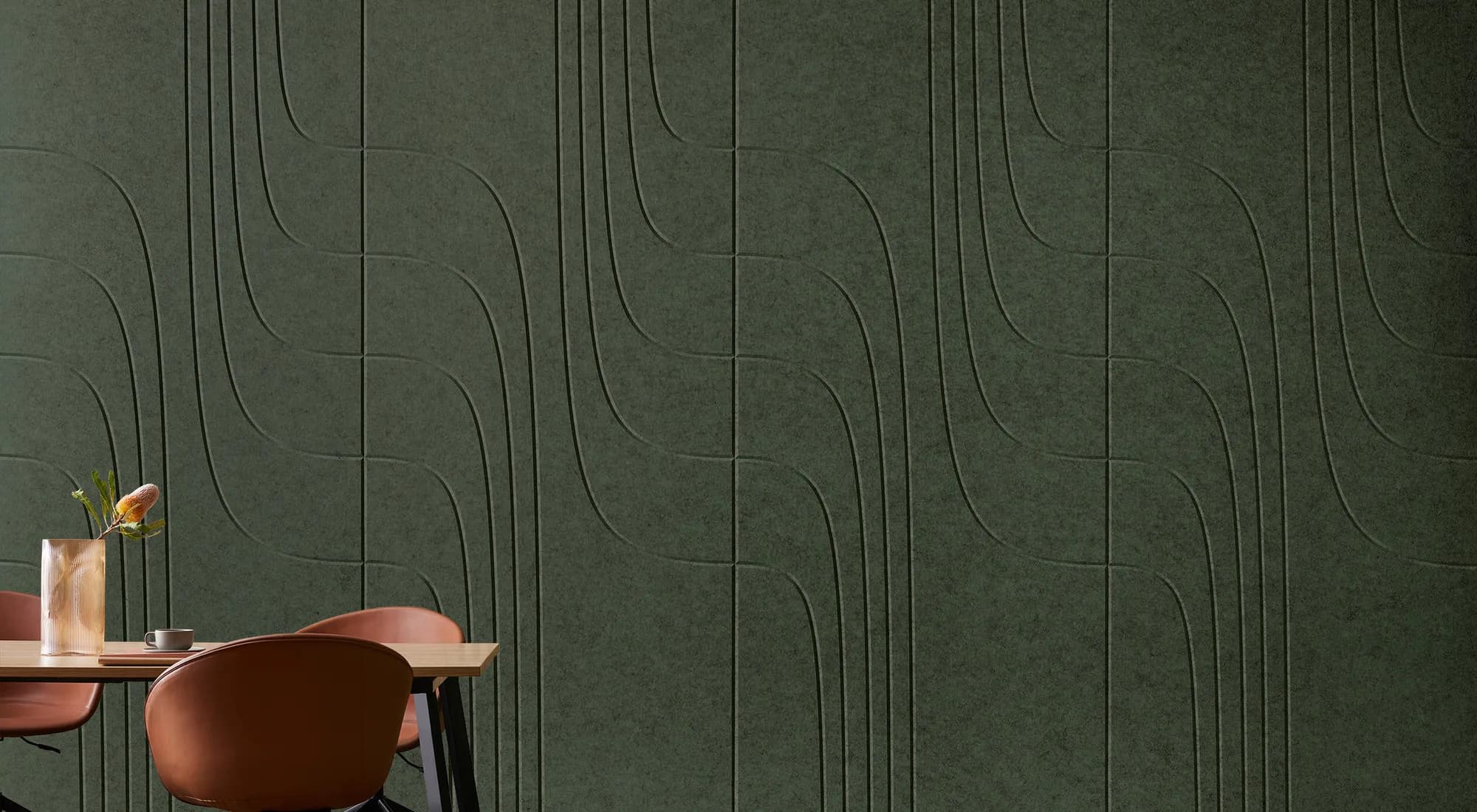
EchoPanel® is pressed from 100% PET felt. Post-consumer recycled content varies by range, from 27% in Dune Tile and Wave Tile through to 80% in EchoPanel® 12mm and the Empire, Palace and Ohm precision-cut panels. Under a microscope, the felt is a dense, disorganised web of fibres with air gaps between them. When a sound wave enters, the air has to squeeze through that web, and the friction dissipates the energy as heat.
Frequency matters. High frequencies — the bulk of human speech (roughly 500Hz–4kHz) — have short wavelengths and are easy to absorb with a thin fibrous layer. Low frequencies have much longer wavelengths and require either greater material thickness or an air gap behind the panel to capture properly.
Thickness matters. A 9mm embossed panel direct-fixed to a wall absorbs about 20% of incoming sound (αw 0.20). A 12mm EchoPanel direct-fixed absorbs 30% (αw 0.30). A 24mm EchoPanel absorbs 45% (αw 0.45). Each step up adds low-frequency performance.
The air gap secret
Mounting the same panel on battens 20–50mm off the wall adds significant low-frequency absorption at almost zero extra material cost. A 12mm EchoPanel goes from αw 0.30 direct-fixed → 0.45 with a 20mm gap → 0.60 with a 50mm gap. That's a doubling of absorption from the same panel, just by installing it differently.
Understanding NRC and αw ratings
Two numbers dominate acoustic product specs: NRC (Noise Reduction Coefficient, American standard) and αw (weighted alpha, European/ISO standard). Both are a single number between 0.00 and 1.00 that tells you roughly what fraction of incoming sound energy a material absorbs.
Noise Reduction Coefficient
The average absorption across four mid-range octave bands (250, 500, 1000, 2000 Hz). NRC 0.60 means the product absorbs roughly 60% of the sound energy that hits it. Standard in North America and often in Australian product sheets.
Weighted Alpha (ISO 11654)
A single value derived from the full absorption curve, weighted against a reference contour. More rigorous about how performance varies with frequency. Standard in Europe and on EchoPanel® product data. In practice αw and NRC agree within about 0.05 for most fibrous absorbers.
Absorption classes A–E
ISO 11654 also maps αw to a letter grade. Higher is better.
- A
- 0.90 – 1.00
- Maximum absorption — purpose-built acoustic tile with deep air gap
- B
- 0.80 – 0.85
- Class B — high absorption. Reached when Ascent Tile is installed with infill (αw 0.90)
- C
- 0.60 – 0.75
- Class C — Ascent Tile direct fix (αw 0.60); EchoPanel® 12mm with 50mm air gap (αw 0.60); EchoPanel® 24mm with 50mm air gap (αw 0.70)
- D
- 0.30 – 0.55
- Class D — EchoPanel 12mm direct-fix (αw 0.30); 24mm direct-fix (αw 0.45)
- E
- 0.15 – 0.25
- Class E — thin panels direct-fixed, e.g. 9mm embossed (αw 0.20)
How many panels do you need?
The honest answer is: it depends on room volume, existing surface materials, panel thickness, and install method. That's what the calculator is for. But as a rough starting point:
- Home office / study (10–15 m²): roughly 4–8 m² of 12mm panels on one wall, direct-fix.
- Meeting room (15–25 m²): 10–15 m² of 12mm panels, preferably on two walls, with a 20mm air gap for better low-mid response.
- Open-plan workspace (100 m²+): a mix of wall panels and ceiling tiles; the calculator will usually suggest both.
- Home theatre (20–30 m²): 24mm panels with 50mm air gap on the rear wall and first reflection points — NRC 0.70 territory.
Use the calculator for a specific recommendation based on your actual room dimensions, surface materials and intended use.
Things people ask before buying
Do acoustic panels block sound between rooms?
No — that's soundproofing, which is a completely different problem. Soundproofing stops sound from passing through a wall (you need mass, density and decoupling for that). Acoustic panels reduce the sound that bounces around inside a single room. If you can already hear a conversation clearly through the wall, panels won't fix that. If the room itself sounds echoey, harsh or fatiguing, panels will.
Will acoustic panels make my room silent?
No, and that's not the goal. Panels reduce reverberation — the lingering echo that builds up from hard surfaces. A treated room still has sound in it; conversations, music and footsteps are all still audible, they just don't smear together into a wash of noise. A completely dead room (anechoic) is actually disorienting to be in.
Can I install acoustic panels myself?
Yes for direct-fix installations. EchoPanel® cuts with a sharp utility knife at 90° to the face and fixes to a clean, drywall Level 3 substrate using a commercial construction adhesive. A professional qualified installer is recommended for optimum results, and we strongly recommend professional installation for air-gap configurations (where consistent cavity depth determines the rated acoustic performance).
What NRC is considered good?
For general office and hospitality work, NRC 0.60 or higher is solid. For critical-listening spaces like home theatres, recording studios or podcast rooms, aim for NRC 0.70+. Remember that NRC depends on how panels are installed — the same panel can go from NRC 0.30 direct-fixed to NRC 0.60 with a 50mm air gap.
Can I use too many panels?
It's rare but possible. Over-treating a room can make it feel muffled or dead — you lose natural room ambience and spatial cues. Our calculator targets a balanced RT60 for the room type you choose, so you end up with the right amount of absorption rather than the maximum.
Ready to treat a room?
Run your room through the calculator, browse the full EchoPanel® range, or compare two panels side-by-side. The installation guide walks through the direct-fix method step by step.