
How to install acoustic wall panels
EchoPanel® is direct-fixed to a wall or ceiling substrate using a commercial construction adhesive. Sound absorption performance is also published at 20mm and 50mm air-gap configurations, summarised further down the page.
A professional qualified installer is recommended for optimum results, though the direct-fix method is achievable for confident DIYers. For ceiling installs, air-gap configurations, and any project with strict specification or fire compliance requirements, book professional installation.
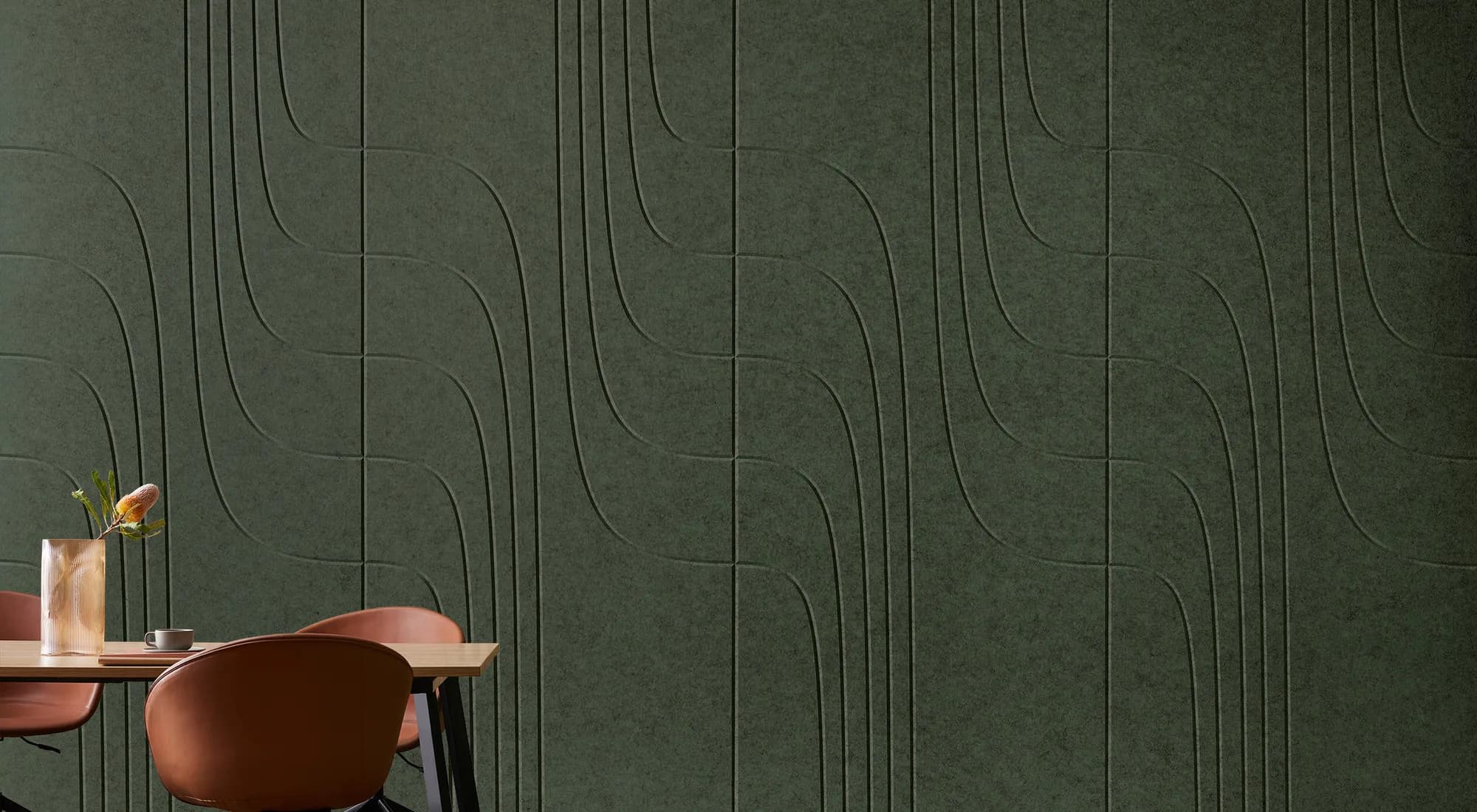
Plan the job before you buy adhesive
A half-hour of layout planning saves hours of cut-and-curse on the wall. Confirm your method, measure the room twice, work out panel layout on graph paper, and only then order materials.
Tools you'll need
Substrate and handling
- Wall or ceiling surface must be clean and free of dust or imperfections that could prevent adhesion. An industry-standard drywall Level 3 finish is recommended.
- Allow for thickness variations due to manufacturing tolerances and any minimal unevenness of substrate.
- Carry boxes and panels upright. Store boxes and panels flat in a cool, dry place with no direct sun, and avoid 65°C or greater. Keep dry and avoid humidity.
- Wear gloves when handling light colours, and protect the panel edges. Upon delivery, inspect all goods for order correctness and damage — no claims will be accepted after panels are installed.
When to hire a professional
A professional qualified installer is recommended for optimum results. Book professional installation for ceiling installs, air-gap configurations (where consistent cavity depth determines the rated performance), complex feature walls, and any project with strict specification or fire compliance requirements. Our Perth team covers WA direct.
Direct fix (glued to wall or ceiling)
EchoPanel® is direct-fixed to the substrate using a commercial construction adhesive. The same method applies equally to walls and ceiling linings.
Prepare the substrate
Ensure the wall or ceiling surface is clean and free of dust or imperfections that could prevent adhesion. An industry-standard drywall Level 3 finish is recommended. Allow for thickness variations due to manufacturing tolerances and any minimal unevenness of substrate.
Set out and orient panels
EchoPanel® has an inherent grain direction — each plain panel has a logo sticker placed in the same corner to assist with correct orientation. Check that all panels are the correct design, colour, shape and batch number before cutting, and place panels face-side down on a clean drop sheet during preparation.
Cut by hand
Insert the blade at 90° to the surface to ensure square edges and best results for butt joins. Use a sharp blade that is not too long or flexible. For best results, use multiple cuts and light pressure. Keep panels flat and use a backing mat, with a secure straight edge for straight cuts. Replace the blade often to maintain sharpness.
Cut by machine (optional)
EchoPanel® can also be cut on a CNC machine, or with a plunge-cut circular saw or band saw using a wave-toothing blade and a metal guide. Do not use serrated blades with side-set teeth. Trial cut on a scrap piece first. Feed against the rotation of the blade using a slow, consistent feed rate to prevent overheating.
Apply adhesive
EchoPanel® can be direct-fixed with a commercial adhesive. It is the installer's responsibility to ensure the adhesive used is appropriate for the product and substrate. The product as tested for AS 5637.1 Group 1 was fixed using HB Fuller Max Bond Fast Grip applied in thin beads spaced approximately 200mm apart across the unexposed face of the panel. Use adhesives per the manufacturer's instructions, and perform a test piece prior to full installation.
Position and press
Panels can flex easily — support each panel with a minimum of two people when positioning vertically to the substrate. Position the panel against the substrate and apply even, gentle pressure across the face. Use minimum pressure at the edges to avoid adhesive squeeze-out. Although there is no set formula for fixing spans, fixing between 450mm to 600mm centres both vertically and horizontally typically keeps the panel rigid.
Adhesive notes
- — It is the installer's responsibility to ensure the adhesive used is appropriate for the product and substrate.
- — Use adhesives per the manufacturer's instructions, and perform a test piece prior to full installation.
- — The product as tested for AS 5637.1 Group 1 was fixed using HB Fuller Max Bond Fast Grip applied in thin beads spaced approximately 200mm apart, then allowed to cure for two days before testing.
- — Apply even gentle pressure when positioning. Use minimum pressure at the edges to avoid adhesives showing.
20mm and 50mm air-gap installations
EchoPanel® sound absorption is published at three configurations: direct fix, 20mm air gap behind the panel, and 50mm air gap. Each configuration requires the panel to be installed over a battened or framed cavity of the specified depth. Consistent cavity depth is what determines the rated acoustic performance, so air-gap installs are best handled by a qualified installer.
Talk to us before specifying an air-gap install, or book professional installation so the framing is built to the depth your specification calls for.
Why a qualified installer matters here
The rated αw values above assume the panel is installed over a cavity of the specified depth (20mm or 50mm) with consistent spacing. Cavity build-up, framing detail and any added infill change the result. For spec-grade compliance, the acoustic engineer's drawings govern, and a professional qualified installer is recommended for optimum results.
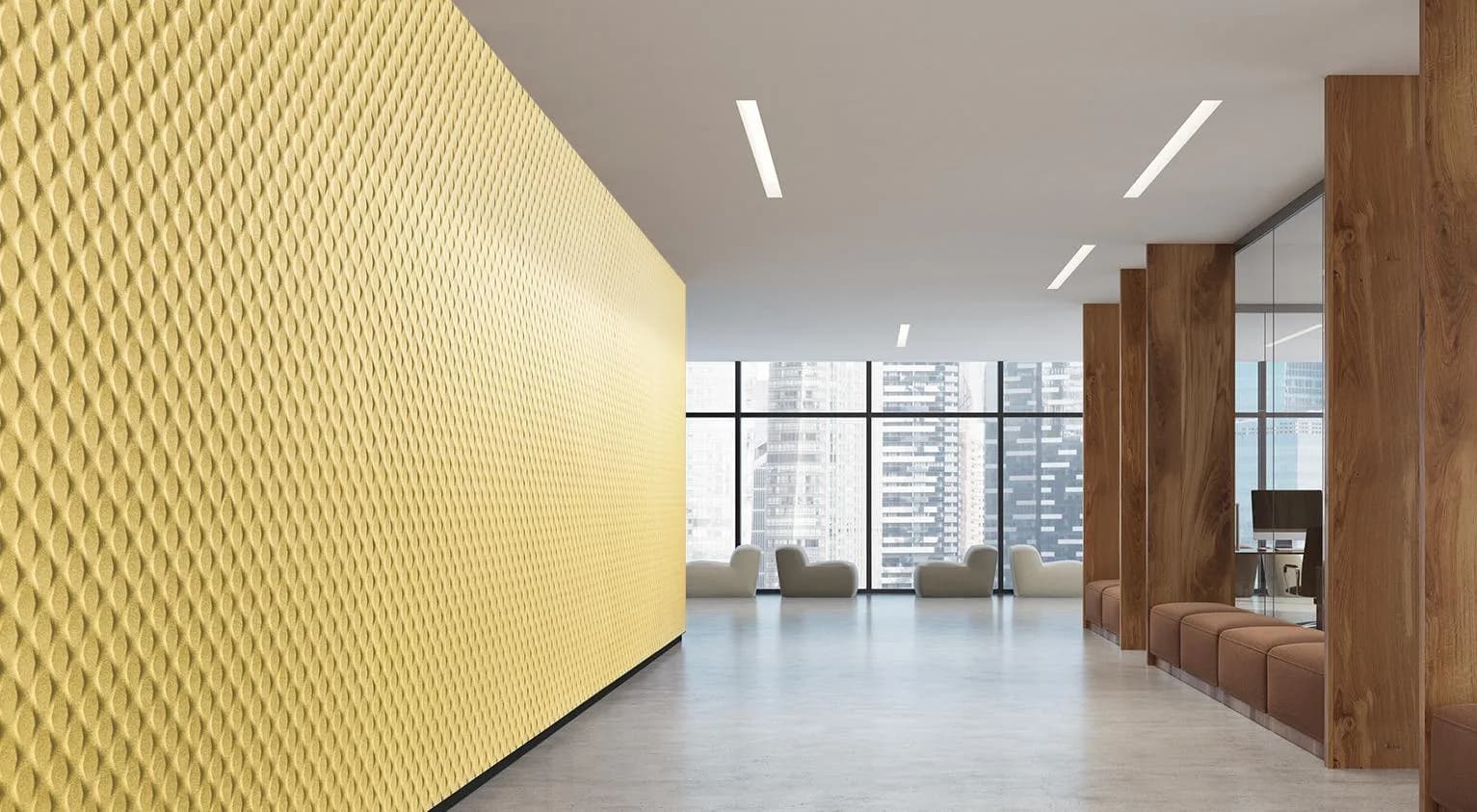
Trimming printed panels, drilling and edge profiles
Trimming printed panels. Due to manufacturing tolerance, EchoPanel® prints are inset from the edge of the panel, leaving an unprinted border around the edges that will need to be trimmed if butt-joining side by side. The unprinted edge varies from panel to panel by approximately 10mm depending on the placement of the printed design. Some designs are printed with a dashed guideline showing where to trim for a clean pattern match.
Drilling. Hold or clamp the sheet securely. Twist drills used for plastics are suitable — two flutes, a point with an included angle of 60° to 90°, and a lip clearance of 12° to 18°. For larger holes, use a diamond-tip hole saw presented at a 45° angle to begin cutting and straightening up when penetrating the panel. Drill speeds up to 1,750 rpm work for smaller holes; speeds as low as 350 rpm for larger holes. Drill holes should be a minimum 15mm centre offset from each corner and slightly oversized to allow for thermal expansion.
Forming corners. Folded corners are achieved seamlessly by carving out an appropriate mitre to the back of the panel, leaving about 5mm thickness of panel to bend around the required angle. The mitres can be routed out or cut with a knife, with the mitre angle matching the corner angle (e.g. a 90° corner requires a 90° mitre).
Edge profiles and T-Joiners. The EchoPanel® system includes 9mm, 12mm and 24mm edge trims to cover exposed panel edges at the end of a wall, and a T-Joiner to neatly bridge two direct-fixed panels. Trim profiles come in 3000mm lengths and can be trimmed on site with a drop saw or hack saw. Friction-fit the edge trim onto the panel edge before fixing the panel to the wall.
Tile and 3D-formed panel installation is a different process
The tile and 3D-formed panel ranges — Ascent Tile, Dune Tile, Wave Tile, Curtain, Empire, Palace and the embossed Gem, Ion, Pico and Zen — each have their own installation guide. The methods, fixings and edge details vary by product.
We strongly recommend professional installation for tile and 3D-formed panel work, particularly on ceilings or where lighting and services need integrating. Each product's installation guide is available on the relevant shop page.
Inspection, cure time and tolerances
- Inspect on delivery
- Upon delivery, inspect all goods for order correctness and damage. Check that all panels are the correct design, colour, shape and batch number (if requested). No claims will be accepted after panels are installed.
- Cure time
- Adhesive cure follows the adhesive manufacturer's instructions. As a reference, the panels tested for the AS 5637.1 Group 1 fire test certificate were installed vertically and allowed to cure for two days before testing.
- Tolerances and grain
- EchoPanel® has an inherent grain direction — each plain panel carries a logo sticker in the same corner to assist with orientation. Exact colour matching cannot be guaranteed between batches, and fibre mix and surface texture may vary.
Acoustic panel installation: common questions
Ready to install?
Order panels direct or have our Perth-based team handle the install from measure-up through to finish. For an accurate recommendation on panel quantity, run your room through the calculator first.